A spa interior in the UAE has to handle more than aesthetics. High humidity, frequent water exposure, strong cleaning routines, and high temperatures can quickly affect poorly selected materials. Floors may become slippery, wall finishes can develop mould, metals can corrode, and certain decorative surfaces may deteriorate faster than expected.
For this reason, material selection should be considered part of the spa’s performance strategy, not simply a design decision. A beautiful finish that cannot tolerate moisture or heat may create maintenance problems soon after installation.
For businesses planning a new spa or renovating an existing one, working with a professional spa interior design company can help balance appearance, durability, hygiene, safety, and long-term maintenance from the beginning.
Why UAE Spa Interiors Need Special Material Selection
A spa naturally creates a demanding indoor environment. Steam rooms, wet treatment areas, showers, pools, wash areas, and humid air all introduce moisture into the space.
Dubai’s climate adds another layer of difficulty. Outdoor heat can place additional demands on building materials, while air-conditioning creates differences between indoor and outdoor temperatures.
The Main Challenges
Spa materials may be exposed to:
- Constant moisture
- Steam and condensation
- Water splashes
- Cleaning chemicals
- High indoor humidity
- Temperature fluctuations
- Heavy foot traffic
- Oils and skincare products
- Frequent sanitisation
Choosing materials based purely on colour or appearance can therefore be a costly mistake.
The better approach is to ask a more practical question: Can this finish continue performing in the environment where it will be installed?
Start With the Floor: Safety Comes First
In a spa, flooring has a direct relationship with visitor safety.
Water, oils, lotions, and condensation can create slippery surfaces, particularly around showers, pools, hydrotherapy areas, and treatment rooms.
Choose Anti-Slip Flooring
Anti-slip surfaces provide better traction in areas where water is regularly present.
Suitable options may include appropriately rated:
- Porcelain tiles
- Textured ceramic tiles
- Stone with suitable surface treatment
- Resin-based flooring systems
- Decorative storage solutions
The correct choice depends on the location and expected exposure.
A flooring material suitable for a dry reception area may not be appropriate beside a shower or pool.
Don’t Judge Slip Resistance by Texture Alone
A surface can look textured without providing the required level of slip resistance.
The specification should consider the intended environment, cleaning requirements, barefoot use, and applicable project standards.
A professional design and fit-out team can help match the flooring specification to the actual conditions of each spa zone.
Porcelain Can Be a Practical Choice for Wet Areas
Porcelain is widely used in commercial interiors because it can combine durability with design flexibility.
It is available in finishes that replicate:
- Natural stone
- Wood
- Concrete
- Marble
- Terrazzo
This allows designers to create a luxurious appearance without automatically choosing a high-maintenance natural material.
Where Porcelain Can Work Well
Depending on the specification, porcelain can be considered for:
- – Spa floors
- – Shower walls
- – Treatment areas
- – Washrooms
- – Corridors
- – Reception areas
However, the specific tile, surface finish, installation method, grout, and slip characteristics still need to be selected according to the area’s conditions.
Moisture Protection Goes Beyond the Surface
One common mistake is focusing on the visible finish while overlooking what is underneath it.
A beautiful tile will not solve a waterproofing problem.
Waterproofing Should Be Planned Behind Wet Finishes
Wet areas require appropriate waterproofing systems beneath the final surface.
This helps protect:
- Substrates
- Walls
- Floors
- Adjacent rooms
- Building structure
Waterproofing details around corners, floor drains, pipe penetrations, and junctions are particularly important.
The best finish cannot compensate for poor installation behind it.
Anti-Mould Materials Help Control Maintenance Problems
Humidity creates favourable conditions for mould growth when moisture remains trapped on surfaces or inside poorly ventilated areas.
This makes material selection and ventilation closely connected.
Use Moisture-Resistant Wall Finishes
Depending on the application, suitable options may include moisture-resistant boards, appropriately specified tiles, waterproof coatings, and other finishes designed for humid environments.
Paint selection also matters.
In areas exposed to elevated humidity, coatings should be selected for their resistance to moisture and the expected cleaning regime rather than simply choosing a colour from a catalogue.
Don’t Create Places Where Moisture Can Hide
Poor detailing can create small gaps and joints where moisture accumulates.
Pay attention to:
- Tile joints
- Silicone joints
- Wall-floor connections
- Corners
- Around plumbing fixtures
- Behind fixed furniture
Good detailing can make cleaning easier while reducing areas where moisture can remain trapped.
Grout Matters More Than Many People Expect
Tiles may receive most of the attention, but grout plays an important role in wet environments.
Traditional porous grout can require more maintenance and may become difficult to keep clean in heavily used areas.
Consider the Cleaning Environment
For demanding commercial spa areas, grout selection should consider:
- Water exposure
- Staining
- Cleaning chemicals
- Frequency of maintenance
- Joint width
- Expected traffic
The right grout system can help maintain the appearance of tiled surfaces for longer and make routine cleaning more manageable.
Heat-Stable Finishes for Spa Interiors
Heat-Stable Finishes for Spa Interiors
Moisture is not the only challenge.
Certain areas of a spa may experience elevated temperatures, especially near steam rooms, saunas, hot treatment areas, and equipment zones.
Materials Should Match the Temperature
Finishes need to be selected according to the actual operating environment.
Potential considerations include:
- Thermal stability
- Resistance to expansion and contraction
- Adhesive performance
- Coating durability
- Resistance to moisture and heat together
The right combination of materials, colors, and layouts can transform an ordinary bathroom into a peaceful retreat.
A material that performs well in a normal air-conditioned room may not perform the same way in a hot and humid treatment area.
Wood Looks Beautiful, But Specification Matters
Wood can add warmth and a natural character to spa interiors. However, natural wood requires careful consideration when used in areas exposed to moisture and heat.
Use Wood Strategically
Instead of placing untreated timber in constantly wet areas, designers can consider appropriately treated timber, engineered products suitable for the application, or high-quality wood-look alternatives.
These can create the desired visual effect while potentially reducing maintenance requirements.
The key is not to eliminate natural-looking materials, but to use them where their performance matches the environment.
Metal Finishes Need Protection Too
Metal accents are common in luxury spa interiors, particularly for fixtures, trims, handles, partitions, lighting, and decorative details.
However, humid environments can accelerate corrosion or affect certain finishes.
Select Finishes for Humid Conditions
Depending on the location, designers may consider corrosion-resistant metals or appropriately treated and coated finishes.
Common considerations include:
- Stainless steel grades
- Protective coatings
- Powder-coated finishes
- Suitable plating
- Hardware designed for humid environments
Choose Wall Finishes That Can Be Cleaned Regularly
Spas require consistent cleaning and hygiene procedures.
This means a wall finish must tolerate more than occasional dusting.
Look for Practical Cleanability
Finishes should ideally be:
- Easy to wipe
- Resistant to routine cleaning
- Durable under repeated use
- Appropriate for the area's humidity
- Resistant to visible staining
Textured surfaces can create visual interest, but excessive texture may make cleaning more difficult.
A good spa interior balances visual richness with practical maintenance.
Ceilings Need Moisture Consideration
Ceiling materials are sometimes overlooked because they do not receive direct water exposure.
However, steam and condensation can still affect ceiling systems.
Pay Attention to Humid Zones
Steam rooms, wet changing areas, and shower zones require ceiling materials and assemblies appropriate for the environment.
Materials should be selected with consideration for:
- Moisture exposure
- Ventilation
- Condensation
- Cleaning
- Access for maintenance
A ceiling system that works perfectly in a dry office should not automatically be assumed suitable for a spa.
Adhesives and Sealants Are Part of the System
The visible finish is only one component of the installation.
Adhesives, sealants, membranes, grout, fixings, and substrates all contribute to the final performance.
Why Compatibility Matters
A finish may fail prematurely if the supporting materials are not appropriate for the environment.
For example, repeated moisture and temperature changes can place stress on joints and connections.
Material specifications should therefore be considered as a complete system rather than as individual products.
Design Different Areas for Different Conditions
One of the most effective ways to improve durability is to stop treating the entire spa as one environment.
A reception area has very different requirements from a steam room.
Reception and Waiting Areas
Focus can be placed on:
One of the most effective ways to improve durability is to stop treating the entire spa as one environment.
A reception area has very different requirements from a steam room.
Reception and Waiting Areas
Focus can be placed on:
- – Luxury appearance
- – Durability
- – Easy maintenance
- – Comfortable finishes
Treatment Rooms
Materials should balance:
- – Hygiene
- – Comfort
- – Cleanability
- – Moisture resistance
Wet Areas
Priority should shift toward:
- – Slip resistance
- – Waterproofing
- – Drainage
- – Moisture durability
Steam and Heat Zones
The focus should include:
- – Heat stability
- – Moisture resistance
- – Appropriate adhesives
- – Safe detailing
This zoning approach allows the design to remain visually consistent without forcing every material to perform in conditions it was never intended for.
Don’t Forget Drainage and Falls
Even the best anti-slip flooring cannot compensate for standing water.
Floor design should encourage water to move efficiently toward drains.
Good Wet-Area Design Considers
- – Floor slopes
- – Drain locations
- – Thresholds
- – Waterproofing
- – Surface texture
- – Cleaning access
The objective is to reduce standing water and make the area easier to maintain.
Maintenance Should Influence the Design From Day One
A spa may look perfect on opening day, but the real test begins after months of daily use.
Ask how each selected finish will behave after hundreds of cleaning cycles, repeated foot traffic, water exposure, and regular maintenance.
Think About the Entire Lifecycle
Before selecting a material, consider:
Installation: Is it suitable for the location?
Daily use: Can it withstand the expected traffic and moisture?
Cleaning: Can staff maintain it efficiently?
Repair: Can damaged sections be replaced without major disruption?
Appearance: Will it continue looking appropriate over time?
A slightly higher initial investment in the right material can sometimes reduce long-term maintenance and replacement costs.
The Best Spa Interiors Combine Luxury With Performance
A durable spa does not have to look industrial.
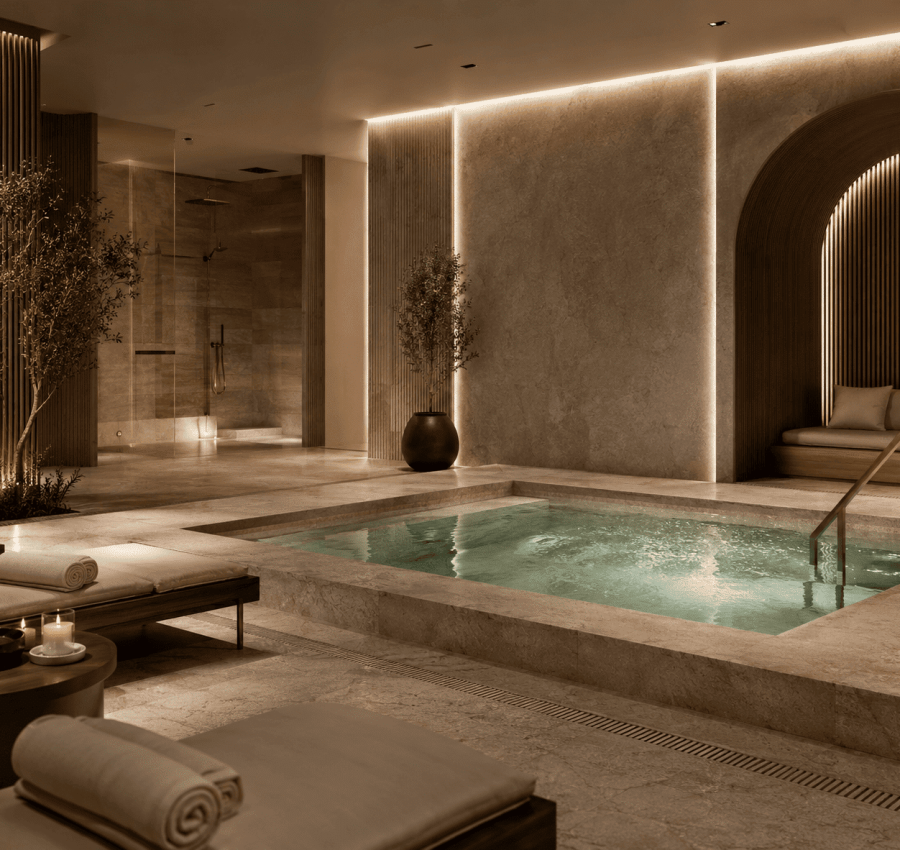
Modern materials allow designers to create sophisticated spaces using stone-effect porcelain, warm wood tones, elegant metal details, textured surfaces, soft lighting, and refined colour palettes.
The difference is in where and how these materials are used.
A successful design knows when to prioritize appearance and when performance must take the lead.
A Practical Material Checklist for UAE Spas
Before approving finishes, ask:
For Floors
- Is the surface suitable for wet conditions?
- Does it provide appropriate slip resistance?
- Is it easy to clean?
- Can it withstand heavy foot traffic?
For Walls
- Is the finish moisture-resistant?
- Can it tolerate routine cleaning?
- Are joints properly detailed?
- Is the substrate suitable for the environment?
For Ceilings
- Can the system tolerate humidity?
- Is condensation being considered?
- Is maintenance access available?
For Metal
- Is the finish appropriate for humid conditions?
- Is corrosion resistance adequate?
- Can the hardware withstand repeated cleaning?
For Heat Zones
- Can the materials tolerate the expected temperature?
- Are adhesives and sealants suitable?
- Have expansion and contraction been considered?
Conclusion
A successful spa interior in the UAE needs to perform beautifully as well as look beautiful. Anti-slip floors can improve safety, moisture-resistant finishes can simplify maintenance, appropriate waterproofing can protect the structure, and heat-stable materials can help demanding areas withstand their operating conditions.
The strongest results come from selecting materials according to the specific conditions of each space rather than choosing finishes purely for their appearance. Reception areas, treatment rooms, wet zones, steam rooms, and service areas each have different performance requirements.
A1 Interior brings together interior design, fit-out planning, material selection, and execution to create spaces where visual quality and practical performance work together. For spa owners and operators, this approach can help build interiors that remain attractive, functional, and easier to maintain even under the demanding humidity, heat, and daily usage conditions found across the UAE.